One of the most frequently asked questions about elliptical training is whether it works your stomach muscles. The short answer is yes—the elliptical engages your core muscles throughout the entire workout—but how much core activation you get depends heavily on your form, resistance settings, and whether you are using specific techniques to maximize abdominal engagement. This guide explains exactly how the elliptical targets your midsection and how to get more core work from every session.
How the Elliptical Engages Your Core
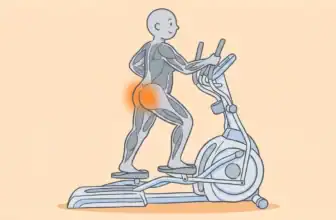
Your core muscles—including the rectus abdominis, obliques, transverse abdominis, and erector spinae—work as stabilizers during elliptical training. Every stride requires your trunk to remain balanced and upright while your arms and legs move in opposite directions. This cross-body coordination creates constant low-level tension across your entire midsection.
The dual-action arm handles amplify this effect. When you push and pull the handlebars while pedaling, your obliques (side abs) engage to resist the rotational forces. The harder you push and pull, the more your core has to work to keep your torso stable.
While this is not the same as doing crunches or planks—which target your abs with high-intensity isolated contractions—it does provide functional core strengthening that translates to better posture, balance, and everyday movement.
Techniques to Maximize Core Engagement on the Elliptical
Let Go of the Handles
The most effective way to increase ab engagement is to release the handlebars entirely. Without handles to stabilize you, your core muscles must do all the balance work. Start with 30-second intervals of hands-free pedaling and gradually build up to several minutes at a time. Keep resistance moderate—this is not about speed, it is about stability.
Increase Resistance
Higher resistance forces your legs to push harder, which in turn requires your core to brace more intensely to maintain posture. Think of it like the difference between walking on flat ground and climbing a steep hill—the hill forces your entire trunk to engage. Learn how to set optimal resistance in our resistance and incline guide.
Engage Your Abs Intentionally
Consciously draw your navel toward your spine and maintain a tight core throughout the workout. This is the same bracing technique used in weight training. It transforms the elliptical from passive core work to active ab engagement. You should feel your abs working within the first few minutes.
Pedal in Reverse
Reverse pedaling changes the movement pattern and shifts your center of gravity backward, which requires your core to work differently. The transition between forward and reverse pedaling—and the balance adjustment it requires—is particularly effective for oblique activation.
Add Intervals
Alternate between 1 minute of high-intensity effort and 1 minute of recovery. The rapid changes in speed and resistance force your core to constantly readjust, preventing it from settling into a passive, autopilot role. For structured interval ideas, read our weight loss workout guide.
Elliptical vs Crunches for Ab Development
Let’s be direct: the elliptical will not give you a six-pack on its own. Visible abdominal definition requires two things: developed ab muscles and low body fat. The elliptical excels at the second part—burning calories and reducing body fat—while providing moderate core muscle stimulation.
Crunches, planks, leg raises, and other ab-specific exercises provide higher-intensity core muscle stimulation. The ideal approach combines both: use the elliptical for cardio and fat burning, and add 10–15 minutes of targeted ab work 3–4 times per week for muscle development.
For more on how the elliptical targets different muscle groups, see our comprehensive elliptical muscle breakdown.
Can You Lose Belly Fat on the Elliptical?
Yes, but with an important caveat: you cannot spot-reduce fat. No exercise—not the elliptical, not crunches, not any machine—removes fat from one specific area. Fat loss occurs across your entire body when you maintain a calorie deficit over time.
The elliptical is an excellent tool for creating that calorie deficit because it burns 400–700 calories per hour while being gentle enough on joints to use daily. Over weeks and months of consistent use, your overall body fat decreases, and belly fat reduces along with it. The more consistent you are, the faster results appear.
To accelerate fat loss, combine elliptical cardio with strength training. Muscle mass increases your resting metabolic rate, meaning you burn more calories even at rest. Explore ways to maximize your calorie burn on the elliptical.
Core-Focused Elliptical Workout (20 Minutes)
Here is a targeted workout designed to maximize abdominal engagement:
Minutes 0–3: Warm up at low resistance, light grip on handles. Focus on posture—shoulders back, chest up, abs braced.
Minutes 3–5: Release handles. Moderate resistance. Hands-free pedaling with intentional core bracing.
Minutes 5–7: High resistance, forward pedaling. Push hard through the handles, feeling oblique engagement.
Minutes 7–9: Reverse pedaling, hands-free. Moderate resistance. Focus on balance and core stability.
Minutes 9–11: Forward pedaling, high resistance interval. Maximum effort for 1 minute, recover for 1 minute.
Minutes 11–13: Release handles again. Low-moderate resistance. Slow, controlled strides with deep core engagement.
Minutes 13–17: Alternating intervals: 30 seconds high resistance with handles, 30 seconds moderate resistance hands-free. Repeat 4 times.
Minutes 17–20: Cool down at low resistance. Light grip. Gradually reduce cadence.
Frequently Asked Questions
How long should I use the elliptical to see stomach results?
Most people begin to notice reduced belly fat after 4–6 weeks of consistent training (3–5 sessions per week, 25–40 minutes per session) combined with a moderate calorie deficit. Visible core toning takes longer—typically 8–12 weeks—and requires additional ab-specific exercises alongside the elliptical work.
Is the elliptical better than walking for stomach fat?
The elliptical burns more calories per hour than walking, so it creates a larger calorie deficit faster. It also engages the core more actively due to the arm movement and balance demands. For stomach fat reduction specifically, the elliptical has a clear advantage over casual walking, though brisk walking is still excellent exercise.
Should I hold the handles or go hands-free for core work?
Both have value. Using the moving handles engages the obliques through rotational resistance. Going hands-free engages the rectus abdominis and deep stabilizers for balance. Alternate between both within the same workout for comprehensive core training.
Does the elliptical work the lower abs?
The lower portion of the rectus abdominis activates during elliptical training, particularly during reverse pedaling and hands-free intervals. However, lower ab activation is moderate compared to exercises like hanging leg raises or reverse crunches. For well-rounded ab development, supplement your elliptical workouts with targeted lower-ab exercises.
Can I do abs on the elliptical every day?
Yes. Because the core engagement during elliptical training is sustained and low-to-moderate intensity (unlike heavy ab exercises that cause muscle fatigue), daily use is safe for most people. The elliptical provides endurance-level core training rather than hypertrophy-level training, so recovery is fast. Check our guide on how often to use an elliptical for more advice.
Choosing a machine? Start with our home elliptical buyer’s guide.
![Does the Elliptical Work Your Stomach? How to Engage Your Core on Every Stride [2026]](https://www.ellipticalhub.com/wp-content/uploads/thumbs_dir/How-to-Lubricate-an-Elliptical-plfb4pwod54bficv8k36f6ny0qa6tn0hv5xek30f98.jpg)
![Does the Elliptical Work Your Stomach? How to Engage Your Core on Every Stride [2026]](https://www.ellipticalhub.com/wp-content/uploads/thumbs_dir/Gain-Muscle-on-an-Elliptical-Machine-plfb4rscqt6w2qa4xkwfk66v7i0x917yjf8dimxmws.jpg)