By Eric Davis | Last Updated: July 4, 2026 | How we put this guide together: muscle-activation basics cross-checked against published exercise-science sources, machine mechanics compared across the models we cover, owner and reader reports for the real-world side. No sponsored placements.
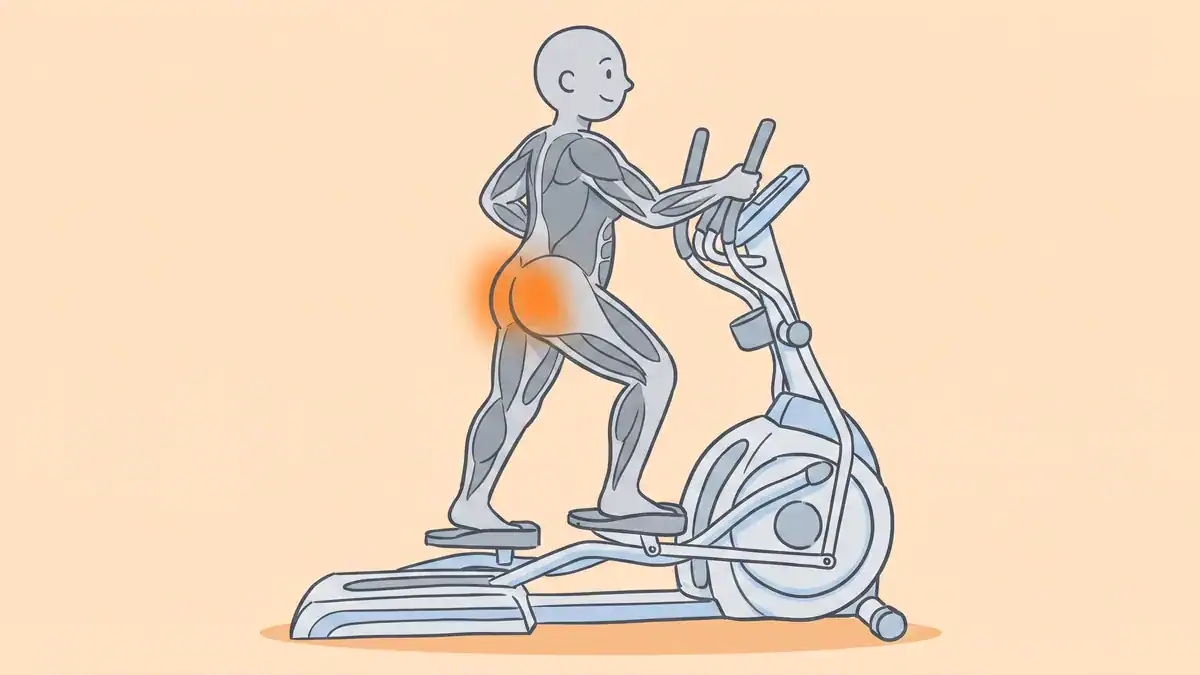
We get this question more than almost any other: is the elliptical actually doing anything, or is it just gliding? Your legs feel it, sure — but which muscles, and how much?
Good news: more of your body is working than you think.
What Muscles Does an Elliptical Work?
An elliptical works most of the major muscle groups in your body — lower body driving the pedals, upper body pulling and pushing the moving handles, core holding it all together:
- Quadriceps — the front-of-thigh muscles powering every downstroke
- Hamstrings — back of the thigh; engage harder on incline and backward pedaling
- Glutes — your largest muscle group; incline is their on-switch
- Calves — firing on every stride as your feet drive the pedals
- Core (abs and obliques) — stabilizing your posture the entire session
- Back (lats) and chest — pulling and pushing the moving handles
- Biceps, triceps, and shoulders — every handle stroke
That list is the machine’s quiet superpower: very few cardio machines touch this much of your body at once, and none do it with this little joint impact.
The Lower Body: Where the Work Lives
Quads do the heaviest lifting on a flat, moderate stride — every push-down of the pedal is theirs. If your thighs burn first, that’s why.
Glutes and hamstrings join in force when you raise the incline. A steep incline turns an elliptical session into something closer to hill climbing, and your backside knows it the next morning.
Calves never get a stride off — they stabilize and drive through every rotation.
One overlooked trick: pedal backward. Reversing the stride shifts the emphasis toward your hamstrings and changes the demand on your knees — a genuinely different stimulus, free of charge.
The Upper Body: Use the Handles or Lose the Benefit
The moving handles are the difference between a leg machine and a full-body machine. Pull them and your lats and biceps work; push and your chest, shoulders, and triceps take over.
Most people rest their hands and let their legs do everything. If that’s you, you’re leaving roughly a third of the workout on the table. Actively drive the handles — pull hard, push hard — and your heart rate tells you immediately.
The Core: Quietly Working the Whole Time
Standing upright on two moving pedals forces your abs, obliques, and lower back to stabilize constantly. It’s not a crunch session — no cardio machine is — but it’s real, continuous engagement.
Want more of it? Let go of the handles for 60-second intervals. Balancing hands-free makes your core do the steadying, and it’s harder than it sounds.
How to Target Specific Muscles on the Elliptical
| Goal | Setting | Why it works |
|---|---|---|
| Glutes and hamstrings | High incline, moderate resistance | Climbing motion shifts load to the posterior chain |
| Quads | Flat incline, high resistance | Heavy pedal pushes are quad territory |
| Hamstrings | Pedal backward | Reverse stride flips the emphasis |
| Arms, back, chest | Drive the moving handles hard | Push-pull turns strides into rows and presses |
| Core | Hands-free intervals | Balance demand forces constant stabilization |
For a complete glute-focused session, our elliptical glute workout builds a full routine around the incline trick.
Does the Elliptical Build Muscle? (Honest Answer)
It builds muscular endurance — the ability of those muscles to work longer without fatigue — and beginners often see some early tone and firmness, especially in the legs.
What it won’t do is add serious muscle size. Growth needs progressively heavier loads than any cardio machine provides. Think of the elliptical as the engine-builder and strength training as the muscle-builder — the pairing works better than either alone.
Where the elliptical genuinely shines is calorie burn with joint mercy — the full story lives in our elliptical vs treadmill for weight loss comparison.
Frequently Asked Questions
What muscles does the elliptical work going backward?
Backward pedaling shifts the emphasis from your quads toward your hamstrings and changes how your glutes fire through the stride. Alternate a few forward and backward intervals and your legs get a noticeably more complete session.
Does the elliptical build muscle or just tone?
Mostly endurance and tone. New exercisers often gain a little visible firmness in the first months, but adding real size requires progressive resistance training. Use the elliptical for conditioning and pair it with strength work for growth.
Can I skip leg day if I use the elliptical?
Tempting — but no. The elliptical conditions your legs; it doesn’t load them heavily enough to replace squats, lunges, or presses. It does make an excellent warm-up or recovery session around leg day.
Is the core engaged on an elliptical?
Yes — continuously, for stabilization. Standing tall (not slumping onto the handles) and adding hands-free intervals both raise the demand. It complements core training; it doesn’t replace it.
Will I see visible changes in my legs?
With consistent sessions, most people notice better muscle definition and endurance within a couple of months — legs that feel firmer and climb stairs easier. Visible change depends on frequency, resistance, and what’s happening in the kitchen.
The Bottom Line
The elliptical works your quads, hamstrings, glutes, calves, core, back, chest, and arms — a genuine full-body machine hiding in the cardio section. Use the incline, drive the handles, throw in some backward intervals, and it earns muscles most machines never touch.
Ready to put it to work? Our elliptical buyer’s guide finds the right machine, and how elliptical training works covers the technique side. Your muscles are waiting on you — all of them.
EllipticalHub is an Amazon Associates affiliate site — we may earn a commission on qualifying purchases at no extra cost to you. Our content is based on independent research and published exercise science.