Arc Trainer vs Elliptical: Which Burns More Calories and Builds More Muscle? [2026]
If you’ve spent any time in a well-equipped gym, you’ve probably noticed a machine that looks like an elliptical but moves differently — the arc trainer. It sits alongside rows of ellipticals, yet most people walk right past it. That’s a mistake, because the arc trainer vs elliptical debate isn’t as straightforward as you might think.
Both machines deliver low-impact cardio that’s easy on your joints, but they differ in how they move your body, which muscles they target, how many calories they burn, and what they cost. Whether you’re outfitting a home gym or just trying to pick the right machine at your local fitness center, understanding these differences can mean the difference between an average workout and a great one.
In this guide, we’ll break down everything you need to know — from real calorie-burn data backed by university research, to muscle activation patterns, joint health considerations, pricing, and a clear decision framework so you can choose with confidence.
What Is an Arc Trainer?
The arc trainer was developed by Cybex International (now part of Life Fitness) as an alternative to the traditional elliptical. Instead of moving your feet in an oval-shaped path, the arc trainer guides them along a curved, arc-shaped motion — hence the name.
This arc motion keeps your foot positioned behind your knee throughout the movement, which is a critical biomechanical distinction. On an elliptical, your foot travels in front of your knee during parts of the stride, creating shearing forces on the knee joint. The arc trainer’s design eliminates this entirely.
Arc trainers come in two versions: lower body only (no moving arms) and total body (with moving handlebars that engage your upper body). Most commercial gym models offer 21 incline levels and up to 100 resistance levels, giving you far more workout variability than a typical elliptical.
What Is an Elliptical Trainer?
The elliptical trainer — also called a cross-trainer — has been a cardio floor staple since the mid-1990s. Your feet move in a smooth, oval-shaped (elliptical) path that simulates a combination of walking, running, and stair climbing without the impact of actually hitting the ground.
Most ellipticals feature moving handlebars for an upper-body component, adjustable resistance, and varying stride lengths. They’re available at virtually every price point, from budget models under $300 to commercial-grade machines costing $5,000 or more. If you’re new to low-impact cardio equipment, our elliptical buyer’s guide covers everything you need to know before purchasing.
Side-by-Side Specs Comparison
Here’s how the two machines stack up on paper:
| Feature | Arc Trainer | Elliptical Trainer |
|---|---|---|
| Motion path | Curved arc pattern | Oval/elliptical pattern |
| Stride length | Fixed 24 inches | Varies: 14–22 inches (adjustable on some models) |
| Resistance levels | Up to 100 levels | Typically 16–25 levels |
| Incline levels | 21 levels | 0–10 on most models (some offer power incline) |
| Machine weight | 380–450 lbs | 100–350 lbs |
| Footprint (L × W) | ~77 × 36 inches | ~70 × 28 inches (varies widely) |
| Max user weight | 300–400 lbs | 250–350 lbs |
| Upper body option | Total Body model only | Standard on most models |
| Foldable models available | No | Yes (select models) |
| Built-in programs | 10–13 programs | 8–30+ programs |
The arc trainer is a heavier, more robust machine by design. It was engineered for commercial gym environments where it needs to withstand constant daily use. Ellipticals span a much wider range — from lightweight home units to commercial-grade models that rival the arc trainer’s build quality.
Calorie Burn Comparison: What the Research Says
This is the question everyone asks first, and fortunately, we have real data to work with.
A study conducted by Dr. John Porcari, a professor in the Department of Exercise and Sport Science at the University of Wisconsin–La Crosse, compared calorie expenditure on the arc trainer versus a leading elliptical trainer. The key finding: the arc trainer burned approximately 16% more calories than the elliptical at the same level of perceived exertion.
Here’s what that looks like in real numbers:
| Metric | Arc Trainer | Elliptical |
|---|---|---|
| Calories per minute | ~10.8 | ~9.3 |
| 30-minute session | ~324 calories | ~279 calories |
| 60-minute session | ~648 calories | ~558 calories |
That 16% gap is meaningful over time. If you work out five days a week for 30 minutes, the arc trainer would burn roughly 225 more calories per week — or about 11,700 extra calories per year. That’s equivalent to roughly 3.3 pounds of fat, just from choosing a different machine.
An important nuance from the study: participants reported similar levels of perceived exertion on both machines, meaning the arc trainer burned more calories without feeling harder. This is partly because the arc trainer’s motion distributes work more evenly across multiple muscle groups, so no single area fatigues as quickly.
A Note on Machine Calorie Displays
Both arc trainers and ellipticals display calorie counts on their consoles, but take these with a grain of salt. Studies have shown that cardio machine displays can overestimate calorie burn by 20–30%. The comparative advantage of the arc trainer holds up in controlled research, but the absolute numbers on any machine’s screen shouldn’t be taken as gospel. For more accurate tracking, pair your workout with a chest-strap heart rate monitor.
Muscle Group Activation: What Each Machine Targets
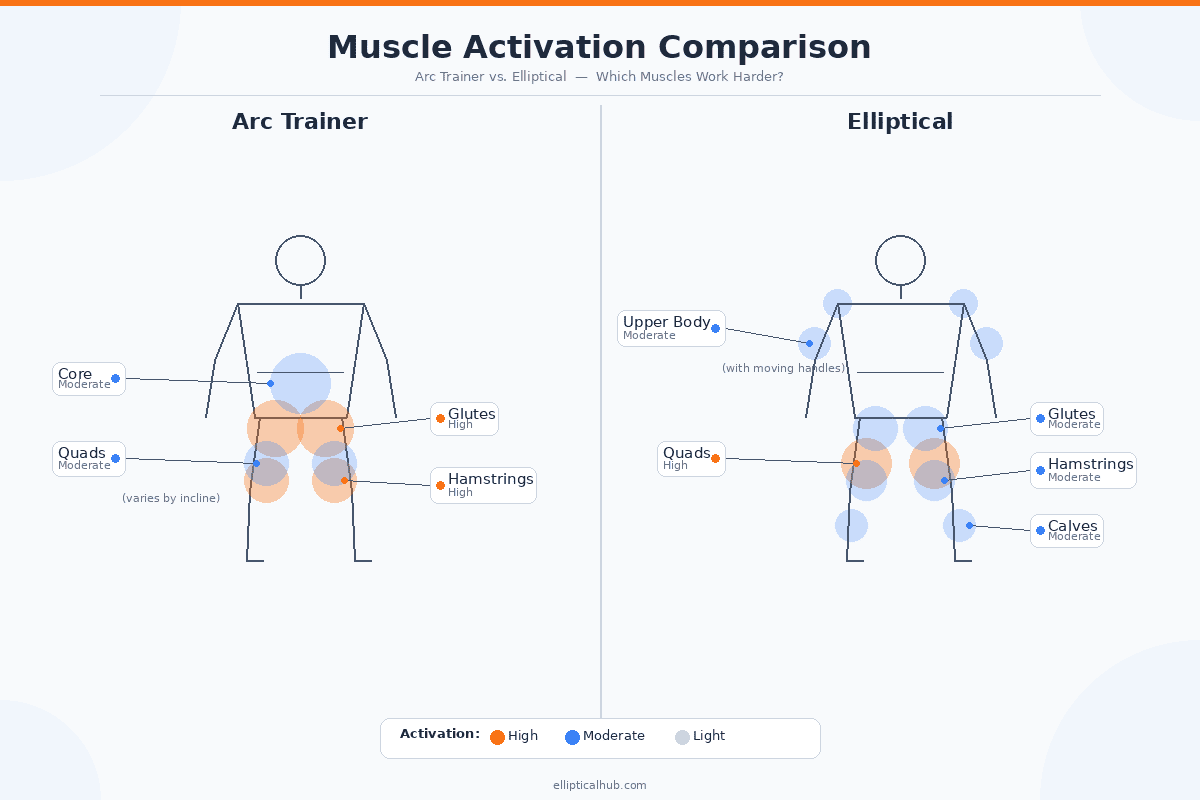
Both machines work your lower body and (with moving handles) your upper body, but they emphasize different muscle groups in different ways.
Arc Trainer Muscle Activation
The arc trainer’s 21 incline levels let you shift the workload across your lower body in a way most ellipticals can’t match:
- Incline levels 0–6 (Glide mode): Primarily targets your glutes and hamstrings. This low, sweeping motion is excellent for posterior chain development.
- Incline levels 7–14 (Stride mode): Engages glutes, hamstrings, and quads more evenly. This is the most balanced setting.
- Incline levels 15–21 (Climb mode): Shifts emphasis heavily to your quadriceps, similar to stair climbing. Great for building quad strength and endurance.
Because the arc trainer keeps your foot behind your knee, your hip and knee joints share the workload more evenly. This means your glutes stay engaged throughout the movement rather than letting your quads and knees do most of the work.
Elliptical Muscle Activation
The elliptical provides a more uniform muscle engagement pattern:
- Quadriceps and hamstrings: Engaged throughout the full stride cycle.
- Glutes: Activated, especially at higher resistance levels or when pedaling in reverse.
- Calves: Engaged during the push-off phase.
- Core: Lightly engaged for stabilization, especially if you avoid holding the handrails.
- Upper body (with moving handles): Chest, back, biceps, and triceps get moderate activation.
For a deeper breakdown of exactly which muscles fire during an elliptical workout, check out our detailed guide on what muscles an elliptical works.
The Verdict on Muscle Activation
The arc trainer gives you more control over which muscles you emphasize, thanks to its wide incline range. The elliptical provides more consistent total-body engagement out of the box, especially with moving handles. If targeted lower-body training is a priority, the arc trainer has a clear edge. If you want balanced, full-body cardio, the elliptical (particularly a total-body model) delivers that efficiently.
Joint Health and Injury Considerations
This is where the arc trainer arguably makes its strongest case.
The arc trainer’s motion path was specifically engineered to reduce stress on the knee joint. Research associated with the machine’s development found that it reduces patellofemoral joint force by approximately 25% compared to walking — and by extension, significantly more compared to running or using a stair climber.
Here’s why that matters:
- Foot position: On an arc trainer, your foot stays behind your knee throughout the motion. On an elliptical, your foot periodically moves in front of your knee, creating a shearing force across the kneecap.
- Load distribution: The arc trainer distributes mechanical load between your hip and knee joints more evenly. On an elliptical, the majority of the load falls on the knee joint.
- Posture: The arc motion allows you to maintain a more upright posture with less forward lean, reducing stress on your lower back.
That said, ellipticals are still considered low-impact machines and are far gentler on your joints than running, jumping, or even walking on a treadmill. If you have healthy knees and no history of joint problems, the elliptical is perfectly fine. But if you’re dealing with knee pain, recovering from a lower-body injury, or are significantly overweight and concerned about joint stress, the arc trainer is the more joint-friendly choice.
Price Range Comparison
This is where the elliptical has a massive advantage.
| Category | Arc Trainer | Elliptical Trainer |
|---|---|---|
| Entry-level | ~$3,000 (refurbished/older models) | $200–$500 |
| Mid-range | $4,000–$6,000 | $500–$1,500 |
| Commercial-grade | $7,000–$9,000+ | $2,000–$5,000+ |
| Popular models | Life Fitness/Cybex 625A (~$7,795), 770A (~$8,245) | Sole E35 (~$1,400), NordicTrack AirGlide 14i (~$1,800) |
The arc trainer was designed as a commercial gym product first. Even the most affordable new arc trainers start around $3,000, and the flagship commercial models push past $8,000. By comparison, you can get a solid, well-reviewed home elliptical for under $1,000.
If budget is a primary concern, the elliptical wins hands-down. You can find quality ellipticals at virtually any price point. If you’re set on getting an arc trainer for your home gym, consider shopping for certified pre-owned or remanufactured units from reputable dealers — you can sometimes find commercial-grade models for 40–60% off retail.
Also keep in mind that arc trainers are significantly heavier (often 400+ pounds) and have a larger footprint than most home ellipticals. If space is tight, a compact or even foldable elliptical might be the more practical choice.
Pros and Cons
Arc Trainer
Pros:
- Burns approximately 16% more calories than an elliptical at the same perceived effort
- 21 incline levels allow precise targeting of different muscle groups
- Reduces knee joint stress by ~25% compared to walking — best-in-class joint protection
- Up to 100 resistance levels for fine-tuned progression
- Commercial-grade build quality and durability
- Encourages a more upright, back-friendly posture
Cons:
- Significantly more expensive ($3,000–$8,000+)
- Very heavy (380–450 lbs), difficult to move or install at home
- Larger footprint — not ideal for small home gyms
- No foldable options available
- Less widely available — limited brand/model selection (primarily Life Fitness/Cybex)
- Steeper learning curve; unfamiliar motion for first-time users
- Lower body–only models don’t include upper body engagement
Elliptical Trainer
Pros:
- Available at every price point ($200 to $5,000+)
- Huge selection of brands, models, and feature sets
- Built-in upper body workout with moving handles on most models
- Lighter weight and smaller footprint for home use
- Foldable models available for small spaces
- Intuitive, natural-feeling motion — minimal learning curve
- Widely available at gyms, hotels, and apartment fitness centers
- Many models offer connectivity, streaming workouts, and smart features
Cons:
- Burns approximately 16% fewer calories than an arc trainer at the same effort level
- Fewer incline options for muscle targeting on most models
- Foot moves in front of the knee, creating more shearing force on the kneecap
- More load concentrated on the knee joint versus the hip
- Budget models may have short stride lengths and low resistance ceilings
- Console calorie estimates are frequently inaccurate (20–30% overestimation)
Who Should Choose Which: A Decision Framework
Choosing between these two machines ultimately comes down to your priorities, budget, and physical needs. Here’s a straightforward framework:
Choose the Arc Trainer If You:
- Have knee problems or joint concerns. The arc motion’s biomechanical design is specifically engineered to minimize knee stress. If you have patellofemoral pain, are recovering from knee surgery, or want to proactively protect your joints, the arc trainer is the better option.
- Want maximum calorie burn per session. The 16% calorie advantage is real, consistent, and backed by peer-reviewed research. If efficiency matters to you, the arc trainer delivers more results per minute.
- Enjoy variety in your lower-body training. The 21 incline levels let you shift between glute-dominant, balanced, and quad-dominant training within a single session. It’s like having three machines in one.
- Have access to one at your gym. If your gym already has arc trainers, there’s no cost barrier — just walk over and start using it.
- Have the budget and space for a home unit. If you can comfortably spend $3,000+ and have room for a 450-pound machine, a home arc trainer is a worthwhile investment.
Choose the Elliptical If You:
- Are on a budget. You can get an excellent home elliptical for $800–$1,500. The price-to-value ratio is unbeatable.
- Want a full-body workout. With built-in moving handles, most ellipticals engage your arms, chest, and back alongside your lower body.
- Have limited space. Ellipticals come in compact and foldable designs that work in apartments, spare bedrooms, and small home gyms.
- Prefer workout variety and tech features. Ellipticals from brands like NordicTrack, Sole, and ProForm offer streaming classes, virtual trails, and app connectivity. Explore your options in our smart elliptical guide.
- Are new to cardio machines. The elliptical motion feels intuitive from the first step. No learning curve required.
- Want something widely available. Ellipticals are everywhere — gyms, hotels, physical therapy clinics, and retail stores. Parts, service, and support are readily available for most brands.
Frequently Asked Questions
Is an arc trainer the same thing as an elliptical?
No. While both are low-impact cardio machines, they use fundamentally different motion paths. An elliptical moves your feet in an oval-shaped pattern, while an arc trainer moves them along a curved arc. This difference affects which muscles are emphasized, how much stress is placed on your joints, and how many calories you burn. The arc trainer was developed as a biomechanically improved alternative to the elliptical, specifically to reduce knee stress and increase calorie expenditure.
Does an arc trainer really burn more calories than an elliptical?
Yes, and the data is solid. A study led by Dr. John Porcari at the University of Wisconsin–La Crosse found that the arc trainer burns approximately 16% more calories than an elliptical at the same level of perceived exertion. In practical terms, that’s roughly 10.8 calories per minute on the arc trainer versus 9.3 calories per minute on the elliptical. Importantly, users didn’t report the arc trainer feeling harder — you burn more without feeling like you’re working more.
Is the arc trainer better for bad knees?
Generally, yes. The arc trainer was specifically designed to reduce patellofemoral (kneecap) joint stress. Its motion path keeps your foot positioned behind your knee at all times, eliminating the shearing forces that can aggravate knee pain on an elliptical. Research associated with its development found a roughly 25% reduction in patellofemoral joint force compared to walking. That said, both machines are low-impact and far gentler on your knees than running or jumping. If you have specific knee issues, consult with your doctor or physical therapist before starting any new exercise program.
Can I get an arc trainer for my home gym?
You can, but expect a significant investment. New arc trainers start around $3,000 for entry-level models and run up to $8,000+ for commercial-grade units like the Life Fitness 770A. They also weigh 380–450 pounds and require a larger footprint than most home ellipticals. Certified pre-owned models from reputable fitness equipment dealers can bring the cost down to $1,500–$3,500. Make sure you have reinforced flooring and enough space — these are not machines you move around easily. For more on setting up your home cardio space, check our elliptical buyer’s guide.
Which muscles does an arc trainer work compared to an elliptical?
Both machines work your quads, hamstrings, glutes, and calves. The key difference is control. The arc trainer’s 21 incline levels let you shift emphasis: low inclines target glutes and hamstrings, mid-range inclines provide balanced engagement, and high inclines isolate your quads like a stair climber. The elliptical provides more uniform lower-body activation and, with moving handles, adds moderate upper-body work for your arms, chest, and back. The total-body arc trainer model also offers moving handles, but the lower body–only version does not.
Are arc trainers worth the higher price?
It depends on your priorities. If joint protection and maximum calorie burn are your top concerns, and you have the budget, an arc trainer offers measurable advantages that justify the cost. However, if you’re buying for a home gym and want the best value per dollar, a mid-range elliptical in the $800–$1,500 range will give you an excellent workout with far more brand options, tech features, and space flexibility. For most home users, the elliptical offers the best balance of performance and value.
How long should I work out on an arc trainer or elliptical?
For general cardiovascular health, the American Heart Association recommends at least 150 minutes of moderate-intensity aerobic exercise per week — that works out to about 30 minutes, five days a week. Both machines can deliver this effectively. If weight loss is your primary goal, aim for 30–45 minutes per session at moderate to high intensity. The arc trainer’s higher calorie-burn rate means you could achieve similar results in slightly less time compared to an elliptical.
The Bottom Line
The arc trainer vs elliptical comparison isn’t about one machine being universally “better” — it’s about which machine is better for you.
The arc trainer wins on calorie burn (16% more at the same effort), joint protection (25% less knee stress than walking), and targeted lower-body training (21 incline levels). If your gym has one, you should absolutely be using it.
The elliptical wins on price (quality models from $500 vs $3,000+), accessibility (available everywhere, in every size), full-body engagement (built-in upper body on most models), and home-gym practicality (lighter, smaller, foldable options).
If you’re shopping for a home machine, start with our complete elliptical buyer’s guide to compare models at every price point. And if you’re exploring other types of low-impact cardio, our guide to seated elliptical machines covers another excellent option worth considering.
This article was last updated in 2026. We regularly review and update our content to ensure accuracy. EllipticalHub.com is a participant in the Amazon Services LLC Associates Program.
Which Should You Choose? Our Verdict
Choose the Arc Trainer if: You want maximum calorie burn per minute, prefer a more intense lower-body workout, or your gym has one available. The Arc Trainer’s unique arc motion provides an aggressive workout that many athletes prefer for high-intensity interval training.
Choose the elliptical if: You want upper-body engagement, prefer a smoother and more natural stride, or are shopping for a home gym. Ellipticals are far more widely available, come in a broader price range, and offer dual-action arms that the Arc Trainer lacks.
For many users, the practical answer comes down to availability and budget. Arc Trainers are primarily found in commercial gyms and cost $3,000–$8,000 for home models. Quality ellipticals start under $500 and go up to $3,000 for premium home models. If you are building a home gym, the elliptical offers better value and versatility. Explore our elliptical beginner’s guide to get started.
How to Maximize Results on Either Machine
Regardless of which machine you choose, these strategies will help you get more out of every session:
Use interval training: Alternate between 1–2 minutes of high intensity and 1–2 minutes of recovery. This approach burns more calories than steady-state cardio and improves cardiovascular fitness faster.
Increase resistance, not just speed: Higher resistance engages more muscle fibers, particularly in the glutes and hamstrings. This builds strength while burning calories. Learn more in our guide on choosing the right resistance and incline.
Mind your posture: Stand upright, engage your core, and avoid leaning on the handles. Poor posture reduces calorie burn and can lead to back pain. Review common elliptical mistakes to refine your form.
Track your progress: Use a fitness tracker compatible with ellipticals to monitor heart rate, calories, and workout consistency over time.
Frequently Asked Questions
Is the Arc Trainer harder than the elliptical?
Most users perceive the Arc Trainer as more challenging at equivalent settings. The arc motion pattern loads the glutes and quads more aggressively than a standard elliptical stride. However, difficulty is relative—you can make any elliptical workout intense by increasing resistance and speed.
Can I get the same workout on an elliptical as an Arc Trainer?
You can achieve comparable cardiovascular benefits and calorie burn on an elliptical by using higher resistance and incorporating upper-body engagement. The primary difference is in the motion pattern, not the overall workout effectiveness.
Is the Arc Trainer better for glutes?
The Arc Trainer does emphasize glute activation due to its deeper arc motion. However, an elliptical with adjustable incline and high resistance can provide excellent glute engagement as well. See our elliptical glute workout guide for targeted routines.
Are Arc Trainers worth the higher price?
For commercial gym settings, Arc Trainers are durable and popular. For home use, the price premium is difficult to justify for most users. A quality elliptical at $800–$1,500 provides comparable workout benefits at a fraction of the cost. Check our elliptical buyer’s guide for home recommendations.
Which Should You Choose? Our Verdict
Choose the Arc Trainer if: You want maximum calorie burn per minute, prefer a more intense lower-body workout, or your gym has one available. The Arc Trainer’s unique arc motion provides an aggressive workout that many athletes prefer for high-intensity interval training.
Choose the elliptical if: You want upper-body engagement, prefer a smoother and more natural stride, or are shopping for a home gym. Ellipticals are far more widely available, come in a broader price range, and offer dual-action arms that the Arc Trainer lacks.
For many users, the practical answer comes down to availability and budget. Arc Trainers are primarily found in commercial gyms and cost $3,000–$8,000 for home models. Quality ellipticals start under $500 and go up to $3,000 for premium home models. If you are building a home gym, the elliptical offers better value and versatility. Explore our elliptical beginner’s guide to get started.
How to Maximize Results on Either Machine
Regardless of which machine you choose, these strategies will help you get more out of every session:
Use interval training: Alternate between 1–2 minutes of high intensity and 1–2 minutes of recovery. This approach burns more calories than steady-state cardio and improves cardiovascular fitness faster.
Increase resistance, not just speed: Higher resistance engages more muscle fibers, particularly in the glutes and hamstrings. This builds strength while burning calories. Learn more in our guide on choosing the right resistance and incline.
Mind your posture: Stand upright, engage your core, and avoid leaning on the handles. Poor posture reduces calorie burn and can lead to back pain. Review common elliptical mistakes to refine your form.
Track your progress: Use a fitness tracker compatible with ellipticals to monitor heart rate, calories, and workout consistency over time.
Frequently Asked Questions
Is the Arc Trainer harder than the elliptical?
Most users perceive the Arc Trainer as more challenging at equivalent settings. The arc motion pattern loads the glutes and quads more aggressively than a standard elliptical stride. However, difficulty is relative—you can make any elliptical workout intense by increasing resistance and speed.
Can I get the same workout on an elliptical as an Arc Trainer?
You can achieve comparable cardiovascular benefits and calorie burn on an elliptical by using higher resistance and incorporating upper-body engagement. The primary difference is in the motion pattern, not the overall workout effectiveness.
Is the Arc Trainer better for glutes?
The Arc Trainer does emphasize glute activation due to its deeper arc motion. However, an elliptical with adjustable incline and high resistance can provide excellent glute engagement as well. See our elliptical glute workout guide for targeted routines.
Are Arc Trainers worth the higher price?
For commercial gym settings, Arc Trainers are durable and popular. For home use, the price premium is difficult to justify for most users. A quality elliptical at $800–$1,500 provides comparable workout benefits at a fraction of the cost. Check our elliptical buyer’s guide for home recommendations.
![Arc Trainer vs Elliptical: Which Burns More Calories and Builds More Muscle? [2026]](https://www.ellipticalhub.com/wp-content/uploads/thumbs_dir/fitness-tracker-for-elliptical-plfb3ful29d9mm7rpi6gj0acwul7cgxnctym1iwpq4.jpg)
![Arc Trainer vs Elliptical: Which Burns More Calories and Builds More Muscle? [2026]](https://www.ellipticalhub.com/wp-content/uploads/thumbs_dir/sole-elliptical-buyers-guide-hero-rpwn5kckk5cl9v8kqdi73ckc210zvwfa3ju63w4i0s.webp)