
By Eric Davis | Last Updated: July 4, 2026 | Stride guidance below reflects the ranges manufacturers and fitness retailers commonly recommend by height, cross-checked against owner feedback from tall and petite users. No sponsored placements.
Stride length is the single most important specification when choosing an elliptical trainer. The wrong stride length makes workouts feel awkward and uncomfortable, while the right one produces a smooth, natural motion that you can sustain for 30–60 minutes without strain. This guide explains how stride length works, how to find the ideal length for your height, and why adjustable stride machines offer the best versatility.
What Is Elliptical Stride Length?
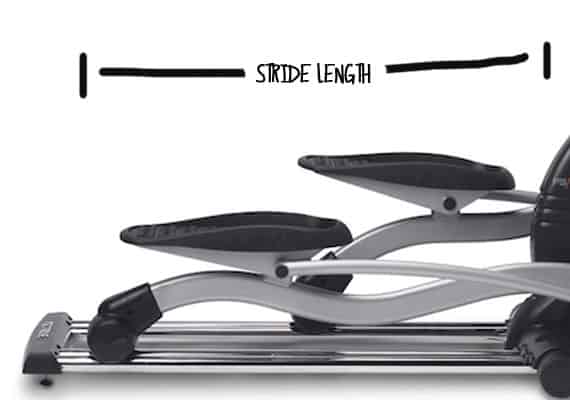
Stride length is the distance, measured in inches, that each pedal travels from its front-most position to its rear-most position during one full revolution. It represents the total range of motion for each leg. Standard home ellipticals range from 14 inches to 22 inches, while commercial gym machines typically offer 20–22 inches.
Think of stride length as the machine’s equivalent of your natural walking or jogging step. If the stride is too short, your legs feel cramped and the motion resembles marching in place. If the stride is too long, you overextend and the movement feels stretchy and unstable.
Stride Length by Height: Quick Reference Chart
| Your height | Recommended stride length | Typical machine type |
|---|---|---|
| Under 5′0″ | 12″–14″ | Compact / under-desk |
| 5′0″–5′3″ | 14″–16″ | Compact |
| 5′4″–5′7″ | 16″–18″ | Mid-size |
| 5′8″–6′0″ | 18″–20″ | Full-size |
| 6′1″–6′3″ | 20″–22″ | Full-size / adjustable |
| Over 6′3″ | 22″+ or adjustable stride | Adjustable (e.g. 18″–24″) |
Ranges are the industry-standard starting points — comfort wins over charts. If a stride feels choppy or overstretched, adjust from here.
Use this chart as a starting point. Individual proportions (leg length vs torso) can shift your ideal stride slightly:
Under 5’0″ (152 cm): 14–16 inch stride
5’0″ – 5’3″ (152–160 cm): 16–18 inch stride
5’4″ – 5’7″ (163–170 cm): 18–20 inch stride
5’8″ – 5’11” (173–180 cm): 20 inch stride (standard)
6’0″ – 6’3″ (183–191 cm): 20–22 inch stride
6’4″ and above (193+ cm): 22+ inch stride
The 20-inch stride is considered the industry standard because it accommodates the largest range of heights comfortably. If you are average height (5’4″–6’0″), a 20-inch stride will work well for most workouts.
Why Stride Length Matters for Your Workout
The correct stride length affects nearly every aspect of your elliptical experience:
Comfort: A well-matched stride allows your hips, knees, and ankles to move through their natural range without stress. This means you can work out longer without joint fatigue.
Muscle engagement: A longer stride activates the glutes and hamstrings more fully because your legs extend further with each revolution. A shorter stride shifts emphasis toward the quadriceps. To learn which muscles different stride settings target, see our elliptical muscles breakdown.
Calorie burn: Proper stride length allows you to maintain a faster cadence comfortably, which directly increases calorie expenditure. Working against an awkward stride wastes energy fighting the machine rather than building fitness.
Injury prevention: Mismatched stride lengths force compensatory movements—hip rotation, knee valgus, or ankle pronation—that can cause pain over time. This is especially important for users with existing knee concerns.
Fixed vs Adjustable Stride Length
Fixed stride ellipticals have a set stride length, usually 18 or 20 inches. They are simpler mechanically, which can mean fewer things to break. However, they work best if the stride length matches your body. If multiple family members of different heights share the machine, a fixed stride that fits one person may feel wrong for another.
Adjustable stride ellipticals let you change the stride length—typically from 18 to 22 inches—using a lever, button, or automatic motor. This offers several advantages: multiple users can share the machine comfortably, you can vary your stride mid-workout to target different muscle groups, and you can grow with the machine as your fitness level and preferences change.
Premium models from NordicTrack, Sole, and Bowflex offer power-adjustable stride that changes automatically during preset workout programs—shorter strides for hill climbs, longer strides for flat sprints.
How to Test Your Ideal Stride Length
If you can visit a showroom or gym before buying:
Step 1: Step onto the machine and pedal at a moderate pace for 2–3 minutes. Focus on whether the motion feels natural or forced.
Step 2: Check your knee alignment. At the front of the stride, your knee should not extend past your toes. At the back, your leg should extend comfortably without locking.
Step 3: Listen to your hips. If you feel rocking or twisting in your pelvis, the stride is likely too long. If your knees come up high like marching, it is too short.
Step 4: Try different speeds. A good stride length feels comfortable at both slow warm-up speeds and faster cardio speeds.
If buying online, use the height chart above and choose an adjustable-stride model to minimize risk. Combine this with information from our complete buyer’s guide for a well-informed purchase.
Stride Length and Compact Ellipticals
Space-saving ellipticals often compromise on stride length to reduce their footprint. Many compact models offer 14–16 inch strides, which work well for shorter users but feel choppy for anyone over 5’6″. If space is tight but you are tall, look for compact designs that achieve a longer stride through engineering rather than sheer size—center-drive ellipticals, for example, often deliver 20-inch strides in a shorter frame. See our best ellipticals for small spaces guide for compact models with full-length strides.
Frequently Asked Questions
What happens if I use an elliptical with the wrong stride length?
Using a stride that is too short or too long will feel uncomfortable and may cause joint pain in the hips, knees, or lower back over time. Short-term, you will fatigue faster because your body works against the machine’s motion rather than with it. If your current elliptical feels off, adjusting resistance and incline can partially compensate.
Is a 20-inch stride length enough for a 6-foot person?
Yes, for most people at 6 feet tall. The 20-inch stride is the standard for commercial gym machines and accommodates users from about 5’3″ to 6’2″ comfortably. If you are over 6’2″ or have unusually long legs relative to your height, look for a 22-inch stride.
Does a longer stride burn more calories?
A longer stride can burn slightly more calories because each revolution covers more distance, engaging the glutes and hamstrings more fully. However, the difference is small compared to the impact of resistance level and workout duration. Focus on finding a comfortable stride first, then adjust resistance for intensity.
Can I change the stride length on my existing elliptical?
Only if your model has an adjustable stride feature. Fixed-stride ellipticals cannot be modified. If you bought a fixed-stride machine that does not fit, the most practical solution is to sell it and purchase an adjustable model.
What stride length is best for walking vs jogging on an elliptical?
Walking uses a shorter, more compact stride—14–18 inches feels natural. Jogging and running use a longer stride—18–22 inches—to match the extended leg motion. If you do both, an adjustable stride machine gives you the flexibility to switch between walking and jogging modes.
![Elliptical Stride Length Guide: Find the Perfect Fit for Your Height [2026]](https://www.ellipticalhub.com/wp-content/uploads/thumbs_dir/exercise-equipments-for-home-plfb2mpl6e9dmpe3fnl0vpn2hwktpupywtqk5y3x30.jpg)
![Elliptical Stride Length Guide: Find the Perfect Fit for Your Height [2026]](https://www.ellipticalhub.com/wp-content/uploads/thumbs_dir/compact-elliptical-small-space-hero-rpx9kv0gaoh6p8lfou0234pb2jyttgc1fanze94zzw.webp)
![Elliptical Resistance and Incline Settings: How to Optimize for Maximum Results [2026]](https://www.ellipticalhub.com/wp-content/uploads/2023/10/ellipticalhub-default-imgae-336x220.jpg)


