If you think the elliptical is just a warm-up machine or a low-key cardio option, you’re missing out on one of the most effective glute-building tools in the gym. With the right settings — high incline, heavy resistance, and a few strategic technique swaps — an elliptical workout can torch your glutes harder than most squat variations, all while sparing your knees and lower back.
In this guide, you’ll get five complete elliptical glute workouts you can start using today, plus the science behind why they work. Whether you’re rehabbing an injury, hate leg day, or just want to add variety to your routine, these workouts will help you build stronger, more defined glutes using nothing but an elliptical machine.
Why the Elliptical Actually Works Your Glutes
Let’s clear something up first: the elliptical isn’t just a calorie burner. When you use the right settings, it becomes a serious glute-training machine. Here’s the anatomy behind it.
The Three Glute Muscles
Your glutes are made up of three distinct muscles, and the elliptical can target all of them:
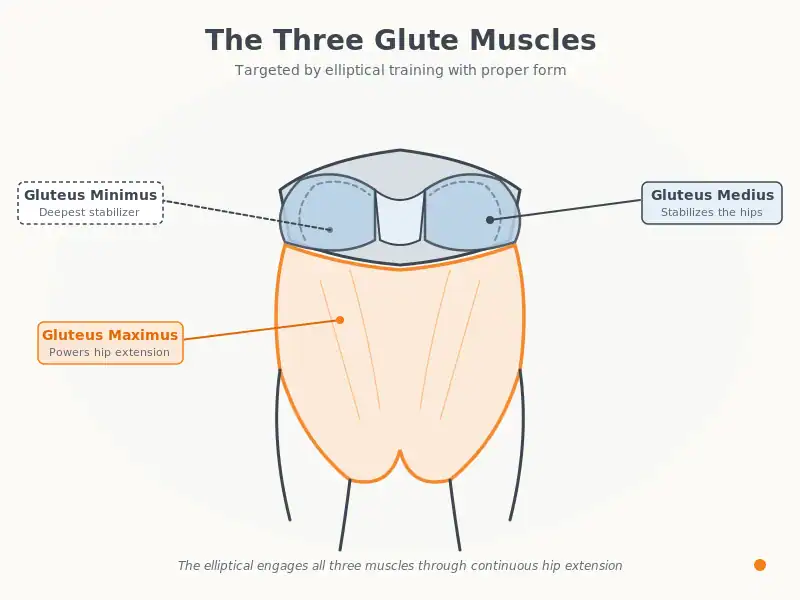
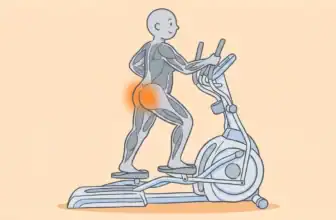
Gluteus Maximus — The largest muscle in your body and the primary driver of hip extension. Every time you push the pedal down and back, your gluteus maximus fires to power the movement. Higher resistance forces harder contractions, turning cardio into strength work.
Gluteus Medius — This muscle sits on the outer surface of your pelvis and stabilizes your hips during the stride. Because you’re standing on a moving platform with no seat, your medius works constantly to keep you balanced — especially when you release the handlebars.
Gluteus Minimus — The smallest and deepest of the three, it assists with hip stabilization and internal rotation throughout the entire elliptical motion.
How Incline and Resistance Change Everything
The default elliptical setting — low resistance, no incline — doesn’t do much for your glutes. But two adjustments change the game:
Incline shifts the pedal path to mimic stair climbing. EMG research shows steeper angles demand greater hip extension effort with every stride, directly increasing gluteus maximus recruitment. For glute-focused work, set your incline to 10 or above on a 1–20 scale.
Resistance determines how hard your muscles work against the flywheel. At low resistance (1–5), your legs are mostly going through the motion. At moderate-to-high resistance (8–15), your glutes generate real force on every stride — like the difference between walking on flat ground and hiking uphill with a pack.
The Reverse Pedaling Advantage
Here’s a technique most people overlook: pedaling backward. Reversing the stride shifts muscular demand away from your quadriceps and onto your glutes and hamstrings, loading your glutes from a different angle and hitting fibers that forward pedaling doesn’t reach. EMG studies confirm that reverse pedaling significantly increases posterior chain activation.
If you want a deeper dive into which muscles the elliptical targets, check out our complete muscle guide.
The 5 Best Elliptical Glute Workouts
Each workout below includes a full breakdown with warm-up, working intervals, and cool-down. Resistance levels are on a 1–20 scale (adjust proportionally if your machine uses a different range). SPM = strides per minute.
A quick note on calories: The estimated calorie burns below are based on a 155-pound (70 kg) person. If you weigh more, you’ll burn more. If you weigh less, you’ll burn slightly fewer. A 30-minute elliptical session at moderate-to-high intensity typically burns between 270 and 400+ calories.
Workout 1: High-Incline Glute Burner
Duration: 30 minutes | Difficulty: Intermediate | Est. Calories: 320–380
This workout uses a steep incline throughout to maximize hip extension and keep your gluteus maximus under constant tension. Push through your heels on every stride.
| Phase | Duration | Incline | Resistance | SPM | Notes |
|---|---|---|---|---|---|
| Warm-Up | 5 min | 5 | 4 | 120–130 | Easy pace, loosen up your hips |
| Build | 3 min | 10 | 8 | 130–140 | Start feeling the incline in your glutes |
| Work Block 1 | 5 min | 15 | 10 | 130–140 | Push hard through your heels |
| Active Recovery | 2 min | 8 | 6 | 120–130 | Bring heart rate down slightly |
| Work Block 2 | 5 min | 18 | 12 | 125–135 | Maximum incline — sit back into each stride |
| Active Recovery | 2 min | 8 | 6 | 120–130 | Shake out your legs |
| Work Block 3 | 5 min | 15 | 11 | 130–140 | Maintain form, drive through heels |
| Cool-Down | 3 min | 3 | 3 | 110–120 | Slow it down, let heart rate drop |
Pro Tip: Resist the urge to lean forward on the handlebars. Stand tall and let your glutes — not your arms — do the work.
Workout 2: Reverse-Pedaling Glute Activation
Duration: 25 minutes | Difficulty: Beginner–Intermediate | Est. Calories: 250–310
Reverse pedaling shifts the workload from your quads to your glutes and hamstrings. This workout alternates direction to keep your muscles guessing. If you’re new to backward pedaling, start with lower resistance until you find your balance.
| Phase | Duration | Direction | Incline | Resistance | SPM | Notes |
|---|---|---|---|---|---|---|
| Warm-Up | 4 min | Forward | 5 | 4 | 120–130 | Get comfortable, find your rhythm |
| Reverse Intro | 3 min | Backward | 8 | 6 | 110–120 | Slow and controlled, feel the glute shift |
| Forward Push | 3 min | Forward | 12 | 9 | 130–140 | High incline, heel-drive focus |
| Reverse Work | 4 min | Backward | 10 | 8 | 115–125 | Squeeze your glutes at the top of each stride |
| Forward Push | 3 min | Forward | 14 | 10 | 130–140 | Push the incline higher |
| Reverse Finisher | 4 min | Backward | 10 | 9 | 115–125 | Last reverse set — maintain form |
| Cool-Down | 4 min | Forward | 3 | 3 | 110–120 | Easy forward pedaling to finish |
Pro Tip: When pedaling backward, keep a light grip on the stationary handles (not the moving arms) for balance. Let go entirely once you feel confident — this forces your glutes and core to stabilize you even more.
Workout 3: HIIT Glute Intervals
Duration: 22 minutes | Difficulty: Advanced | Est. Calories: 300–370
Short, brutal intervals at high resistance with minimal recovery. This workout is designed to spike your heart rate and hammer your glutes with maximum effort. It also triggers excess post-exercise oxygen consumption (EPOC), meaning you continue burning calories after the workout ends. For more on structuring HIIT on an elliptical, see our guide on types of high-intensity interval training.
| Phase | Duration | Incline | Resistance | SPM | Notes |
|---|---|---|---|---|---|
| Warm-Up | 4 min | 5 | 5 | 120–130 | Gradually increase pace |
| Sprint 1 | 30 sec | 12 | 14 | 160–170+ | All-out effort |
| Recovery 1 | 60 sec | 5 | 5 | 110–120 | Catch your breath |
| Sprint 2 | 30 sec | 14 | 15 | 160–170+ | Push harder than Sprint 1 |
| Recovery 2 | 60 sec | 5 | 5 | 110–120 | Active recovery, keep moving |
| Sprint 3 | 30 sec | 14 | 15 | 160–170+ | Maintain intensity |
| Recovery 3 | 60 sec | 5 | 5 | 110–120 | Focus on deep breathing |
| Sprint 4 | 30 sec | 16 | 16 | 160–170+ | Peak effort — empty the tank |
| Recovery 4 | 60 sec | 5 | 5 | 110–120 | Let heart rate come down |
| Sprint 5 | 30 sec | 16 | 16 | 160–170+ | Final push, give it everything |
| Recovery 5 | 60 sec | 5 | 5 | 110–120 | Begin cool-down transition |
| Cool-Down | 4 min | 3 | 3 | 100–110 | Slow, easy pedaling |
Pro Tip: During each sprint, focus on driving through your heels and pushing the pedals back forcefully. The power should come from your glutes and hamstrings, not your toes.
Workout 4: Low-Resistance High-Stride Glute Endurance
Duration: 35 minutes | Difficulty: Beginner | Est. Calories: 280–340
Not every glute workout needs to crush you. This longer, steadier session uses moderate incline and a faster stride rate to build muscular endurance in your glutes. It’s ideal if you’re coming back from an injury, prefer lower-impact training, or want an active recovery day that still targets your glutes. The elliptical’s low-impact nature makes it perfect for this purpose.
| Phase | Duration | Incline | Resistance | SPM | Notes |
|---|---|---|---|---|---|
| Warm-Up | 5 min | 3 | 3 | 120–130 | Light and easy |
| Tempo Block 1 | 8 min | 10 | 6 | 140–150 | Find a sustainable fast pace |
| Slight Bump | 7 min | 12 | 7 | 140–150 | Small increase — stay smooth |
| Tempo Block 2 | 8 min | 10 | 6 | 145–155 | Push the stride rate slightly |
| Final Push | 4 min | 12 | 7 | 150–160 | Fastest pace of the workout |
| Cool-Down | 3 min | 3 | 3 | 110–120 | Gradually slow down |
Pro Tip: This workout is about volume, not max effort. Keep your strides long and fluid. If you feel your form breaking down at higher speeds, drop the SPM by 5–10 and focus on full range of motion.
Workout 5: Combined Glute + Hamstring Circuit
Duration: 30 minutes | Difficulty: Intermediate–Advanced | Est. Calories: 330–400
This workout combines forward incline work (glute emphasis) with reverse pedaling segments (hamstring emphasis) and high-resistance intervals to hit your entire posterior chain. It’s the most well-rounded workout on the list and pairs well with a full-body elliptical strategy.
| Phase | Duration | Direction | Incline | Resistance | SPM | Notes |
|---|---|---|---|---|---|---|
| Warm-Up | 4 min | Forward | 5 | 4 | 120–130 | Easy warm-up |
| Glute Block | 4 min | Forward | 15 | 10 | 130–140 | High incline, heel drive |
| Hamstring Block | 3 min | Backward | 10 | 9 | 115–125 | Controlled reverse pedaling |
| Power Interval | 1 min | Forward | 12 | 14 | 155–165 | High effort burst |
| Recovery | 2 min | Forward | 5 | 5 | 110–120 | Catch your breath |
| Glute Block | 4 min | Forward | 16 | 11 | 130–140 | Increase incline from first block |
| Hamstring Block | 3 min | Backward | 10 | 10 | 115–125 | Slightly higher resistance |
| Power Interval | 1 min | Forward | 14 | 15 | 155–165 | Push harder than first interval |
| Recovery | 2 min | Forward | 5 | 5 | 110–120 | Active recovery |
| Burnout Finisher | 2 min | Backward | 12 | 12 | 120–130 | Reverse pedal at high resistance |
| Cool-Down | 4 min | Forward | 3 | 3 | 100–110 | Slow cool-down |
Pro Tip: During the power intervals, grab the moving handlebars and push/pull with your arms to add an upper-body element. During the glute and hamstring blocks, use the stationary handles or go hands-free to isolate your lower body.
6 Form Tips to Maximize Glute Engagement on the Elliptical
Getting the most out of these workouts isn’t just about settings — your technique matters just as much. Here are the form cues that separate a mediocre elliptical session from a real glute workout.
1. Push Through Your Heels — This is the single most important cue. When you push through your toes, your quads dominate. Shift your weight into your heels and you’ll immediately feel your glutes take over. Drive the pedal down and back, not just down.
2. Stand Tall — Don’t Lean Forward — Hunching over the console or leaning on the handlebars takes load off your glutes. Stand upright, chest open, shoulders back, core engaged.
3. Take Longer Strides — Short, choppy strides keep the movement in your quads. Longer strides increase hip range of motion, which means greater glute stretch and contraction. If your machine has adjustable stride length, set it to 20 inches or longer.
4. Release the Handlebars (When Safe) — Letting go forces your glutes and core to work harder for stability. Start with a light grip, then progress to hands-free during moderate-intensity segments.
5. Sit Back Slightly Into Each Stride — Imagine you’re about to sit down in a chair. That slight hip hinge loads your glutes more aggressively. Just a subtle shift backward during the push phase makes a big difference.
6. Squeeze at the Bottom of Each Stride — At the lowest point of each pedal stroke, consciously squeeze your glute on the working side. This mind-muscle connection dramatically improves activation.
How Often Should You Do These Workouts?
Aim for 3 to 4 elliptical glute sessions per week, rotating between the five options based on energy level: Workouts 3 and 5 for high-energy days, Workouts 1 and 2 for moderate days, and Workout 4 for recovery days.
If you’re also strength training (squats, deadlifts, hip thrusts), schedule elliptical glute workouts on separate days or use them as a finisher. Our article on how long you should be on the elliptical covers timing in more detail.
Frequently Asked Questions
Does the elliptical really build glutes?
Yes. The elliptical engages all three glute muscles through continuous hip extension and stabilization demands. It won’t build glutes as aggressively as heavy barbell hip thrusts, but it can absolutely build size and strength when you use high incline (10+), moderate-to-high resistance (8–15), and proper heel-drive technique. For people who can’t squat or deadlift due to injury, it’s one of the best alternatives available.
Is pedaling backward on the elliptical safe?
Absolutely. Elliptical machines are designed to handle reverse pedaling — the flywheel and mechanics work the same in both directions. Start at a lower speed and resistance until you’re comfortable with the balance demands, and keep a light grip on the stationary handles until you find your rhythm. Reverse pedaling is used regularly in physical therapy settings.
What incline is best for glutes on the elliptical?
Set your incline to at least 10 on a 1–20 scale. The sweet spot for most people is between 12 and 16. Going to 18–20 maximizes glute engagement but is very demanding — save those levels for short work intervals. If your elliptical doesn’t have adjustable incline, increase resistance instead and focus on heel-drive technique.
Can I do elliptical glute workouts every day?
You can, but it’s not ideal. Your glutes need recovery time to grow and strengthen. Aim for 3 to 4 sessions per week with at least one rest day between intense sessions like the HIIT workout. Workout 4 works well on lighter days without much recovery concern.
How long before I see results from elliptical glute workouts?
Most people notice improved glute activation and tone within 3 to 4 weeks of consistent training (3–4 sessions per week). Visible muscle growth typically takes 6 to 8 weeks, depending on nutrition and starting fitness level. Combining these workouts with a high-protein diet (0.7–1 g per pound of body weight) accelerates results.
Does the elliptical also work your stomach muscles?
Yes — your core muscles are engaged throughout the elliptical motion to maintain balance and posture, especially when you release the handlebars or increase incline. It won’t give you a six-pack on its own, but it contributes to core conditioning. We cover this in depth in our article on whether the elliptical works your stomach.
Choosing a machine? Start with our our complete buyer’s guide to home ellipticals.
![5 Best Elliptical Glute Workouts: Build Your Glutes Without Squats [2026]](https://www.ellipticalhub.com/wp-content/uploads/thumbs_dir/knee-pain-ellipticalhub-plfbk96nbkdxbhshiru74rj7gzpl1josc23b3pz6f0.jpg)
![5 Best Elliptical Glute Workouts: Build Your Glutes Without Squats [2026]](https://www.ellipticalhub.com/wp-content/uploads/thumbs_dir/pexels-photo-327533-plfbk0q3m22cf04rw66k0bo24iva49r7aw7xs8bpz0.jpeg)